Australian Art History a List of Different Kinds of Australian Arts
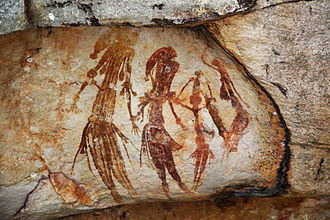
Bradshaw rock paintings constitute in the due north-west Kimberley region of Western Commonwealth of australia

Aboriginal pictographs known as Wandjina in the Wunnumurra Gorge, Barnett River, Kimberley, Western Commonwealth of australia
Ethnic Australian fine art or Australian Aboriginal art is fine art made by the Indigenous peoples of Australia and in collaborations betwixt Indigenous Australians and others. It includes works in a wide range of media including painting on leaves, wood carving, rock etching, sculpting, ceremonial clothing and sand painting. This article discusses works that pre-date European colonization every bit well as contemporary Indigenous Australian fine art past Ancient Australians. These accept been studied in recent years and have gained much international recognition.[1]
Traditional Indigenous fine art
In that location are several types of ancient art, and means of making art, including rock painting, dot painting, rock engravings, bark painting, carvings, sculptures, and weaving and string art.
Stone painting
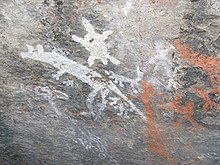
Aboriginal Namadgi National Parkfeaturing a Kangaroo, Dingoes,Echidna or Turtles, totems and stories are created using dots.

This photo shows the painting of Baiame made by an unknown Wiradjuri artist in "Baiame'south cave", nigh Singleton, NSW. Find the length of his artillery which extend to the two trees either side.
Australian Indigenous art is the oldest unbroken tradition of art in the world. The oldest firmly dated rock art painting in Australia is a charcoal drawing on a stone fragment establish during the earthworks of the Narwala Gabarnmang stone shelter in south-western Arnhem Land in the Northern Territory. Dated at 28,000 years, it is one of the oldest known pieces of stone art on Earth with a confirmed engagement. Stone fine art, including painting and engraving or carving, can exist found at sites throughout Australia. Rock paintings announced on caves in the Kimberley region of Western Australia known as Bradshaws. They are named after the European, Joseph Bradshaw, who outset reported them in 1891. To Aboriginal people of the region they are known every bit Gwion Gwion [2] or Giro Giro.[3] Other painted stone fine art sites include Laura, Queensland,[4] Ubirr, in the Kakadu National Park,[5] Uluru,[6] and Carnarvon Gorge.[vii]
Aboriginal rock art has been around for a long period of fourth dimension, with the oldest examples, in Western Commonwealth of australia'southward Pilbara region and the Olary district of South Commonwealth of australia, estimated to exist up to around 40,000 years onetime.[8] Examples have been found that are believed to depict extinct megafauna such as Genyornis [9] and Thylacoleo [10] as well as more than recent historical events such equally the arrival of European ships.[xi]
Stone engravings
Stone engraving depends on the type of stone beingness used. Many different methods are used to create rock engravings. In that location are several different types of Stone art across Australia, the most famous of which is Murujuga in Western Australia, the Sydney rock engravings around Plymouth in New South Wales, and the Panaramitee rock art in Primal Australia. The Sydney engravings, depicting carved animals and humans, accept their own peculiar style non establish elsewhere in Australia.
The stone fine art at Murujuga is said to be the globe'southward largest drove of petroglyphs[12] and includes images of extinct animals such equally the thylacine. Activity prior to the last ice historic period until colonisation is recorded.
Dot painting
Dot painting consists of diverse pigment colours similar xanthous (representing the lord's day), brown (the soil), red (desert sand) and white (the clouds and the sky). These are traditional Aboriginal colours. Dot paintings can be painted on annihilation though in ancient times they were painted on rocks, in caves, etc. The paintings were mostly images of animals or lakes, and the Dreamtime. Stories and legends were depicted on caves and rocks to represent the artists' religion and beliefs.
On modern artwork, dots are generally applied with one of two instruments, (1) bamboo satay sticks and (2) ink bottles. The larger flat end of bamboo satay sticks are more commonly used for unmarried application of dots to paintings, but the abrupt pointier end is used to create fine dots. To create superimposed dotting, artists may take a bunch of satay sticks, dip the pointy ends into the paint and then transfer it onto the sheet in quick successions of dotting.[13]
Bawl painting
Bawl paintings are regarded as fine art, and today the finest fine art commands high prices on the international fine art markets. The best artists are recognized annually in the National Aboriginal & Torres Strait Islander Fine art Laurels.
Aerial desert "country" landscapes
From aboriginal times, Australian ancient culture likewise produced a genre of aeriform landscape art, often titled just "country". It is a kind of maplike, bird'south-eye view of the desert landscape, and information technology is often meant to tell a traditional Dreaming story. In the distant by, the mutual media for such artwork were stone, sand or torso painting, merely the tradition continues today in the class of colored drawings with liquid based color on canvas (see section Papunya Tula and "Dot Painting" beneath).
Stone arrangements
Stone arrangements in Australia range from the 50m-bore circles of Victoria, with 1m-high stones firmly embedded in the ground, to the smaller rock arrangements found throughout Australia, such as those near Yirrkala which draw accurate images of thepraus used by Macassan Trepang fishermen and spear throwers.
See Aboriginal rock arrangements for more details.
Carvings and sculpture
- Carved shells – Riji
- Mimih (or Mimi) pocket-sized man-like carvings of mythological impish creatures. Mimihs are and so frail that they never venture out on windy days lest they exist swept away like leafage litter. It is said their necks are so thin a slight breeze might snap their heads off. If approached by men they will see a rock scissure; if no cleft is there, the rocks themselves will open up and seal behind the Mimih.
- Fibre sculpture
Weaving and string-art
- Basket weaving – see Australian Ancient fibrecraft
- Necklaces and other jewellery, such as those from the Tasmanian Aborigines
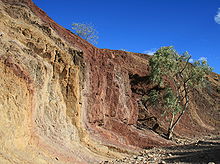
Ochre Pits in key Australia where a variety of clay earth pigments were obtained
Symbols
Sure symbols inside the Ancient modern art move retain the aforementioned meaning beyond regions although the meaning of the symbols may change within the context of a painting. When viewed in monochrome other symbols can look like, such equally the circles within circles, sometimes depicted on their own, sparsely, or in clustered groups. Depending upon the tribe of which the artist is a murnanember, symbols such as bivouac, tree, loma, excavation hole, waterhole, or spring can vary in significant. Use of the symbol can be clarified further past the utilise of color, such as water being depicted in blue or black.
Many paintings past Ancient artists, such as those that represent a "dreamtime story", are shown from an aerial perspective. The narrative follows the lie of the land, as created by ancestral beings in their journey or during creation. The modernistic day rendition is a reinterpretation of songs, ceremonies, rock art and body art that was the norm for many thousands of years.
Whatsoever the meaning, interpretations of the symbols should be fabricated in context of the entire painting, the region from which the artist originates, the story behind the painting, and the style of the painting, with boosted clues being the colours used in some of the more modern works, such as blue circles signifying water.(Source: Aboriginal Symbols – Indigenous Australia)[14]
Religious and cultural aspects of Aboriginal art
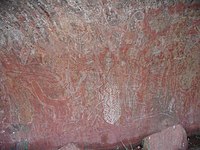
Aboriginal art at Uluru
Ancient art at Uluru

Aboriginal art showing Barramundi fish
Traditional indigenous art about e'er has a mythological undertone relating to the Dreamtime of indigenous Australian artists. Wenten Rubuntja, an indigenous landscape artist, says information technology is hard to detect whatever art that is devoid of spiritual significant:
Doesn't thing what sort of painting nosotros do in this land, it still belongs to the people, all the people. This is worship, work, culture. It's all Dreaming. In that location are 2 ways of painting. Both ways are important, because that's civilisation. – source The Weekend Australian Magazine, April 2002
Story-telling and totem representation feature prominently in all forms of Aboriginal artwork. Additionally, the female grade, particularly the female womb in X-ray style, features prominently in some famous sites in Arnhem Land.
Graffiti and other destructive influences
Many culturally pregnant sites of Aboriginal rock paintings have been gradually desecrated and destroyed by encroachment of early settlers and modern-day visitors. This includes the devastation of art past clearing and construction work, erosion caused by excessive touching of sites, and graffiti. Many sites now belonging to National Parks have to exist strictly monitored past rangers, or closed off to the public permanently.
Contemporary Indigenous fine art
Modern Aboriginal artists

Picture of Albert Namatjira at the Albert Namatjira Gallery, Alice Springs Cultural Precinct, in 2007.

Rainbow serpent byJohn Mawurndjul, 1991
In 1934 Australian painter Rex Batterbee taught Aboriginal artist Albert Namatjira western way watercolour landscape painting, along with other Aboriginal artists at the Hermannsburg mission in the Northern Territory. It became a popular way, known every bit the Hermannsburg Schoolhouse, and sold out when the paintings were exhibited in Melbourne, Adelaide and other Australian cities. Namatjira became the first Aboriginal Australian citizen, every bit a result of his fame and popularity with these watercolour paintings.
In 1966, i of David Malangi's designs was produced on the Australian 1 dollar note, originally without his cognition. The subsequent payment to him by the Reserve Bank marked the first instance of Aboriginal copyright in Australian copyright police.
In 1988 the Aboriginal Memorial was unveiled at the National Gallery of Australia in Canberra made from 200 hollow log coffins, which are similar to the blazon used for mortuary ceremonies in Arnhem Land. It was made for the bicentenary of Australia'south colonisation, and is in remembrance of Aboriginal people who had died protecting their land during conflict with settlers. Information technology was created by 43 artists from Ramingining and communities nearby. The path running through the middle of it represents the Glyde River.[15]
In that same twelvemonth, the new Parliament House in Canberra opened with a forecourt featuring a design past Michael Nelson Tjakamarra, laid every bit a mosaic.
The late Rover Thomas is another well known modern Australian Aboriginal artist. Born in Western Commonwealth of australia, he represented Australia in the Venice Biennale of 1991. He knew and encouraged other now well-known artists to paint, including Queenie McKenzie from the Due east Kimberley / Warmun region, equally well as having a strong influence on the works of Paddy Bedford and Freddy Timms.
In the late 1980s and early 1990s the piece of work of Emily Kngwarreye, from the Utopia customs n e of Alice Springs, became very popular. Although she had been involved in craftwork for most of her life, it was only when she was in her 80s that she was recognised every bit a painter. Her works include Earth's Cosmos. Her styles, which changed every year, accept been seen as a mixture of traditional Aboriginal and contemporary Australian. Her rise in popularity has prefigured that of many Indigenous artists from key, northern and western Australia, such every bit Kngwarreye'south niece Kathleen Petyarre, Minnie Pwerle, Dorothy Napangardi, Lena Pwerle, Angelina Ngale (Pwerle) and dozens of others, all of whose works have become highly sought-after. The popularity of these often elderly artists, and the resulting pressure placed upon them and their health, has become such an outcome that some art centres have stopped selling these artists' paintings online, instead placing prospective clients on a waiting list for work.[16]
Current artists in faddy include Jacinta Hayes, popular for her iconic representation of "Bush Medicine Leaves" and "Beloved Ants", Rex Sultan (who studied with Albert Namatjira), Trephina Sultan and Reggie Sultan, Bessie Pitjara and Joyce Nakamara, among others.[17]
Despite concerns about supply and demand for paintings, the remoteness of many of the artists, and the poverty and health issues experienced in the communities, there are widespread estimates of an industry worth close to one-half a billion Australian dollars each year, and growing apace.[18]
Papunya Tula and "dot painting"
In 1971–1972, art teacher Geoffrey Bardon encouraged Aboriginal people in Papunya, north due west of Alice Springs to put their Dreamings onto sail. These stories had previously been drawn on the desert sand, and were at present given a more permanent form.
The dots were used to encompass secret-sacred ceremonies. Originally, the Tula artists succeeded in forming their own company with an Aboriginal Proper noun, Papunya Tula Artists Pty Ltd,[19] however a time of disillusionment followed as artists were criticised by their peers for having revealed too much of their sacred heritage. Secret designs restricted to a ritual context were now in the marketplace place, made visible to Australian Aboriginal painting. Much of the Aboriginal art on brandish in tourist shops traces back to this way adult at Papunya. The virtually famous of the artists to come up from this motility was Clifford Possum Tjapaltjarri. Likewise from this motion is Johnny Warangkula, whose Water Dreaming at Kalipinya twice sold at a record toll, the second time being $486,500 in 2000.
The Papunya Collection at the National Museum of Australia contains over 200 artifacts and paintings, including examples of 1970'due south dot paintings.[20]
Bug

Albert Namatjira refueling for a trip to Alice Springs, around 1948.
There take been cases of some exploitative dealers (known as carpetbaggers) that have sought to turn a profit from the success of the Aboriginal art movements. Since Geoffrey Bardon's fourth dimension and in the early years of the Papunya movement, there has been concerns nigh the exploitation of the largely illiterate and non-English language speaking artists.
One of the main reasons the Yuendumu movement was established, and later flourished, was due to the feeling of exploitation amongst artists:
"Many of the artists who played crucial roles in the founding of the fine art centre were aware of the increasing interest in Aboriginal art during the 1970s and had watched with business concern and curiosity the developments of the fine art movement at Papunya amongst people to whom they were closely related. There was also a growing private market for Aboriginal art in Alice Springs. Artists' experiences of the private market were marked by feelings of frustration and a sense of disempowerment when buyers refused to pay prices which reflected the value of the Jukurrpa or showed little interest in agreement the story. The establishment of Warlukurlangu was ane way of ensuring the artists had some control over the purchase and distribution of their paintings." (Source: "Warlukurlangu Artists". warlu.com. Archived from the original on 2005-07-23.)
Other cases of exploitation include:
- painting for a lemon (auto): "Artists accept come up to me and pulled out photos of cars with mobile phone numbers on the back. They're asked to pigment 10-15 canvasses in exchange for a machine. When the 'Toyotas' materalise, they oft go far with a flat tyre, no spares, no jack, no fuel." (Coslovich 2003)
- preying on a ill artist: "Fifty-fifty coming to town for medical treatment, such as dialysis, tin can brand an creative person easy prey for dealers wanting to make a quick profit who congregate in Alice Springs" (op.cit.)
- pursuing a famous artist: "The late (great) Emily Kngwarreye…was relentlessly pursued past carpetbaggers towards the cease of her career and produced a large only inconsistent body of work." According to Sotheby's "We take about one in every 20 paintings of hers, and with those we look for provenance we can be 100% sure of." (op.cit.)
In March 2006, the ABC reported fine art fraud had hit the Western Australian Aboriginal Art movements. Allegations were made of sweatshop-similar conditions, false works past English backpackers, overpricing and artists posing for photographs for artwork that was not theirs. A detective on the instance said:
"People are clearly taking reward…Especially the elderly people. I hateful, these are people that, they're non educated; they haven't had a lot of contact with white people. They've got no real bones agreement, you know, of the police force and fifty-fifty business concern law. Obviously they've got no real business concern sense. A dollar doesn't really take much of a pregnant to them, and I think to treat anybody like that is just… it's just not on in this country."Call for ACCC to investigate Ancient Art industry, ABC PM, 15 March.
In August 2006, following concerns raised about unethical practices in the Indigenous art sector, the Australian Senate initiated an inquiry into bug in the sector. It heard from the Northern Territory Art Minister, Marion Scrymgour, that backpackers were often the artists of Aboriginal art being sold in tourist shops around Australia:
"The cloth they phone call Aboriginal art is almost exclusively the piece of work of fakers, forgers and fraudsters. Their work hides behind simulated descriptions and dubious designs. The overwhelming majority of the ones you see in shops throughout the country, non to mention Darling, are fakes, pure and uncomplicated. In that location is some anecdotal show here in Darwin at least, they have been painted past backpackers working on industrial scale wood production."[21]
The inquiry's final study made recommendations for changed funding and governance of the sector, including a code of practice.
Aboriginal art movements and cooperatives
Australian Indigenous fine art movements and cooperatives take been central to the emergence of Indigenous Australian art. Whereas many western artists pursue formal training and work as individuals, near contemporary Indigenous art is created in community groups and fine art centres.[22]
Many of the centres operate online art galleries where local and international visitors can purchase works directly from the communities without the demand of going through an intermediary. The cooperatives reverberate the diversity of art across Indigenous Australia from the north westward region where ochre is significantly used; to the tropical due north where the use of cross-hatching prevails; to the Papunya style of art from the fundamental desert cooperatives. Art is increasingly condign a significant source of income and livelihood for some of these communities.
Awards

US President George W. Bush examines a Yirrkala Bark Painting at the Australian National Maritime Museum, 2007
The winners of the West Australian Indigenous Arts Awards were announced on 22 Baronial 2013. From over 137 nominations from throughout Australia, Churchill Cann won the Best West Australian Piece (A$x,000) and Due north Queensland artist Brian Robinson won the Best Overall prize (A$50,000),[23]
Aboriginal art in international museums
The Museum for Australian Ancient art "La grange" (at Neuchâtel, Switzerland) is i of the few museums in Europe that dedicates itself entirely to this kind of art. During seasonal exhibitions, works of fine art by internationally renowned artists are beingness shown. Also, the Musée du Quai Branly, Paris, has an "Oceania" collection,[24] which includes works past Australian Aboriginal artists Lena Nyadbi, Paddy Nyunkuny Bedford, Judy Watson, Gulumbu Yunupingu, John Mawurndjul, Tommy Watson, Ningura Napurrula and Michael Riley.[25]
Two museums that solely exhibit Australian Aboriginal fine art are the Museum of Contemporary Ancient Art (AMU), in Utrecht, Kingdom of the netherlands and the Kluge-Ruhe Ancient Art Collection of the Academy of Virginia.[26] [27]
~
References
- Bound upward^ Caruna, Due west.(2003)'Ancient Art' Thames and Hudson, London, p.7
- Leap up^ Doring, Jeff Gwion Gwion: Chemins Secrets Et Sacrés Des Ngarinyin, Aborigènes D'Australie (Gwion Gwion: Hole-and-corner and Sacred Pathways of the Ngarinyin Aboriginal People of Australia) Könemann 2000 ISBN 9783829040600 p. 55
- Jump upwardly^ Worms, Ernest Contemporary and prehistoric rock paintings in Central and Northern North Kimberley Anthropos Switzerland 1955 p. 555
- Jump up^ "Rock Art Sites & Tours". Quinkan & Regional Cultural Centre. 2009. Retrieved 29 August 2013.
- Jump upwardly^ Department of Sustainability, Surround, Water, Population and Communities (2012). "Ubirr fine art site". Australian Regime. Retrieved29 August 2013.
- Bound up^ Department of Sustainability, Environment, Water, Population and Communities (2013). "Rock art sites". Australian Government. Retrieved29 August 2013.
- Jump upwards^ "Pre-history of Carnarvon Gorge". Australian Nature Guides. Retrieved29 August 2013.
- Jump upward^ Rock Fine art, Aboriginal Art Online, retrieved April 2008.
- Bound up^ Masters, Emma (31 May 2010). "Megafauna cave painting could exist 40,000 years old". Australian Broadcasting Corporation. Retrieved29 Baronial 2013.
- Jump up^ Akerman, Kim; Willing, Tim (March 2009). "An ancient stone painting of a marsupial lion, Thylacoleo carnifex, from the Kimberley, Western Commonwealth of australia". Antiquity (journal) . Retrieved 11 Dec 2012.
- Jump upwardly^ Middleton, Amy; AAP (2 August 2013). "Aboriginal rock art may describe first sea arrivals". Australian Geographic. Retrieved 29 Baronial 2013.
- Jump upward^ Department of Environment and Conservation (vi February 2013)."Creation of Western Australia's 100th National Park – Murujuga National Park". Authorities of Western Australia. Retrieved 29 Baronial 2013.
- Jump upward^ "Fine Dot Paintings". Utopia Lane Art . Retrieved 2015-xi-21 .
- Spring upward^ Team AusEmade (2008-09-28). "Aboriginal Symbols". Ausemade.com.au. Retrieved 2013-08-16 .
- Jump up^ Caruana, Wally (2003). Aboriginal Art (2nd ed.). London: Thames & Hudson. p. 226. ISBN 978-0-500-20366-eight.
- Leap up^ Warlayirti Artists, 'Supply and Demand',http://world wide web.balgoart.org.au/art_centre/mainframe.htm, retrieved July 2007
- Jump upwards^ Nazvanov, DR Greg. The Australian Aboriginal Art Investment Handbook, 2010.ISBN 1445776073
- Leap upward^ Senate Continuing Committee on the Environs, Communications, Information technology and the Arts (2007), Indigenous Art: Securing the Future – Australia's Indigenous visual arts and craft sector, Canberra: The Senate
- Jump upwards^ "Papunya Tula Artists". Papunyatula.com.au. Retrieved 2013-08-sixteen .
- Jump upwardly^ Papunya Collection, National Museum of Australia. Retrieved 19 June 2011.
- Jump up^ Sydney Forenoon Herald (2007) Backpackers simulated Aboriginal art, Senate told
- Jump upward^ Wright, Felicity and Morphy, Frances 1999-2000. The Art & Arts and crafts Centre Story. Canberra: ATSIC (three vols).
- Jump up^ Craig Quartermaine (23 August 2013). "Winner of the West Australian Indigenous Art prize announced". SBS World News Australia . Retrieved28 August 2013.
- Jump up^ "musée du quai Branly: Oceania". Quaibranly.fr. Retrieved 2013-08-16 .
- Jump upward^ "Musée du Quai Branly Australian Aboriginal Art Museum at the Aboriginal Art Directory. View information virtually Musée du Quai Branly". Aboriginalartdirectory.com. 2010-07-15. Retrieved 2013-08-16 .
- Jump up^ "Home". AAMU. AAMU. Baronial 2013. Retrieved 28 August 2013.
- Spring up^ "The Kluge-Ruhe Aboriginal Art Collection". Entrada for the Arts at the Academy of Virginia. Rector & Visitors, U.Va. August 2013. Retrieved28 August 2013.

Enregistrer un commentaire for "Australian Art History a List of Different Kinds of Australian Arts"